China Proxy Server: Residential, Mobile & Datacenter
Master China proxy server use. Get residential, mobile, & datacenter IPs for antidetect browsers, ad accounts, & high-volume campaigns.
You launch a China-facing campaign. Creatives are clean. Landing pages pass review. Your antidetect browser setup looks consistent in AdsPower or Multilogin. Then the pain starts. Login checkpoints loop, TikTok or Facebook sessions die early, account warm-up stalls, and half the proxy pool behaves differently depending on city and carrier.
That usually means the problem isn't your ad account workflow alone. It's your network layer. A China proxy server can help, but only if you treat it like infrastructure, not a checkbox. For media buyers, account farmers, and automation teams, China traffic is less about finding any Chinese IP and more about finding the right architecture, the right session logic, and the right expectations.
Table of Contents
- Operating in the Chinese Digital Ecosystem
- Proxy Architectures for China Operations
- Navigating the Great Firewall and Technical Hurdles
- Selecting a China Proxy Server Provider
- Core Use Cases for High-Volume Teams
- The China Performance Reality Check
- Operational Best Practices and Troubleshooting
Operating in the Chinese Digital Ecosystem
If you run high-volume traffic, you've probably seen this pattern. A batch of accounts looks stable in Dolphin Anty or Hidemyacc. You attach a new proxy set, push localized creatives, and platform trust drops fast. The accounts don't always get hard-banned. They just become fragile. More captchas. More SMS checks. Lower tolerance for normal activity.
That happens because China-facing operations sit inside a much bigger and messier proxy market than many might realize. A 2022 academic study captured 9,077,278 residential-proxy IPs, found 4,661,934 located in China, and identified 399 residential proxy services, including 64 new Chinese services, which shows how large and active the domestic ecosystem already was (academic characterization of residential proxies in China).
That scale cuts both ways. You have options. You also have noise. Large pools don't automatically mean stable pools, trusted pools, or pools that behave consistently for Facebook ad accounts, TikTok Business, account farming, or cloaking checks.
What this means in practice
For operators, the first decision isn't “Do I need a China proxy server?” It's “What exact China behavior do I need?”
- Chinese exit identity: You need to appear local for ad review, geo-targeted offers, or feed inspection.
- Session continuity: You need accounts to keep the same network identity long enough to build trust.
- Local observation: You need to see how links, redirects, prices, or app flows render from inside China.
- Automation tolerance: You need a pool that doesn't collapse when attached to browser farms and scripted workflows.
The market is big enough to support serious operations. It's also big enough to hide a lot of bad inventory.
If you're vetting providers or testing routing assumptions, this guide on using a proxy server to China is useful context. The main point is simple. A China proxy server is not one thing. It's a stack of trade-offs, and the wrong trade-off shows up first in bans, failed checks, and bad data.
Proxy Architectures for China Operations
The proxy type you choose changes how long accounts survive, how much scraping you can push, and how expensive each workflow becomes. For China operations, generic proxy advice usually fails because platform trust and cross-border routing pressure hit at the same time.
What each proxy type actually buys you
Datacenter proxies are the blunt instrument. They're cheap, fast enough for many tasks, and easy to scale for scraping, health checks, or simple automation. They're also the easiest to cluster and the easiest for platforms to distrust when you use them on Facebook or TikTok account operations. If your use case is account creation, ad account maintenance, or long-lived browser identities, datacenter ranges are usually where trouble starts.
Residential proxies are the practical default for most serious buyer teams. They inherit the credibility of consumer networks, which gives them a better trust profile for login flows, account warm-up, and geo-targeted campaign checks. They cost more and they're less predictable than datacenter on raw consistency, but they align much better with how platforms expect normal users to connect.
Mobile proxies are often the highest-trust option for aggressive account work. They're useful when your flow involves repeated logins, fragile account histories, or moderation-heavy surfaces. The downside is operational cost and lower control. They're not always the cleanest fit for large scraping jobs or stable desktop-like browser fingerprints.
IPv6 proxies can be attractive on price and availability, but they're not a universal shortcut. A cheap IPv6 block may be fine for broad crawling or low-friction tasks. It's a weak choice when the target platform, account history, or anti-fraud model expects behavior that looks like a normal consumer residential session.
Practical rule: Match the proxy to the risk layer. Use cheaper inventory for data collection. Use higher-trust inventory for identities you can't afford to burn.
China proxy type comparison
| Proxy Type | Typical Trust Score | Cost Model | Primary China Use Case |
|---|---|---|---|
| Residential | High | Higher, usage-sensitive | Ad account management, geo checks, account farming |
| Mobile | Very high | Highest, limited control | Fragile social accounts, verification-heavy workflows |
| Datacenter | Low to medium | Lowest, scalable | Scraping, monitoring, bulk requests |
| IPv6 | Low to medium | Low | Broad crawling where platform trust matters less |
The details matter more than the labels. A residential pool with weak routing or dirty reuse can still underperform a disciplined ISP or datacenter setup for certain jobs. But as a rule, if you're pairing proxies with AdsPower, GoLogin, Multilogin, or Hidemyacc to manage Facebook and TikTok accounts, residential and mobile are the serious options.
Where buyer teams usually land
Most high-volume operators end up with a mixed stack:
- Residential for core identities: Main browser profiles, ad account operators, warm-up sessions.
- Mobile for recovery or sensitive accounts: Accounts already under review pressure or tied to high-value spend.
- Datacenter for support tasks: Crawling, uptime checks, content fetches, pre-validation.
- IPv6 for low-risk collection: Cheap scale where rejection doesn't hurt much.
If you need a cleaner framework for these differences, this breakdown of proxy types is a good reference point. The operational rule stays the same. Don't save money on the layer that determines whether your accounts stay alive.
Navigating the Great Firewall and Technical Hurdles
A lot of operators think failure in China means the proxy is slow. That's often wrong. The bigger issue is that China's censorship layer can detect and interfere with proxy traffic before speed becomes the main problem.
Why simple rotation fails
According to guidance on proxy use in China, the Great Firewall uses Deep Packet Inspection, and proxies that rely only on IP rotation often fail unless they add transport-layer obfuscation or encryption (Deep Packet Inspection and proxy detection in China). That changes how you should evaluate a China proxy server.
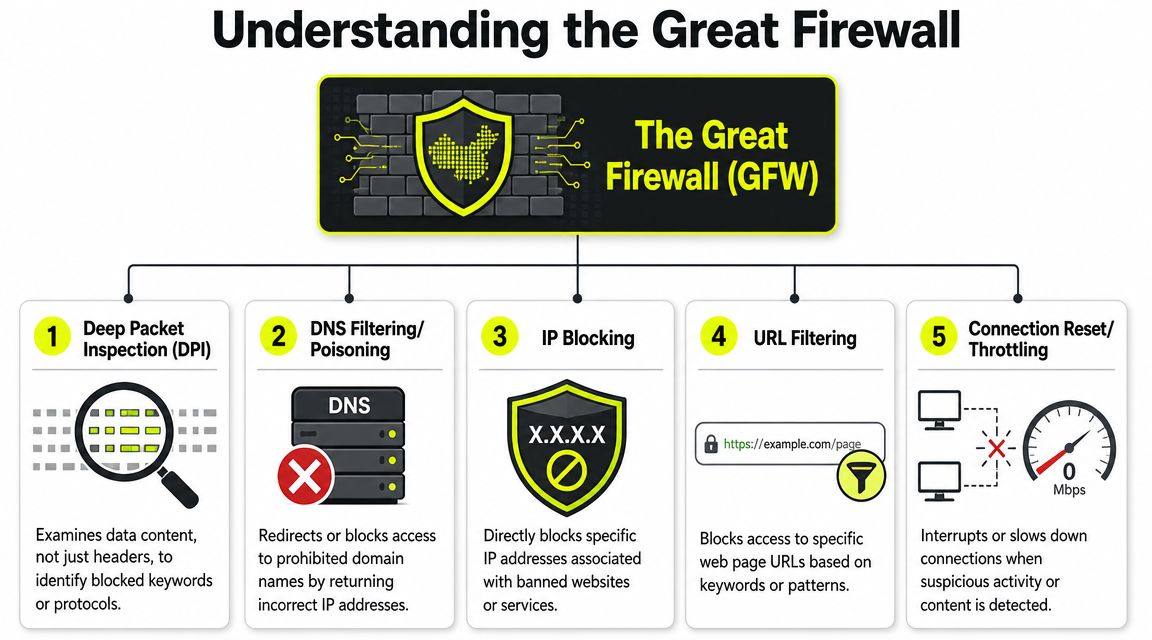
If your stack only swaps IPs but leaves obvious proxy traffic patterns untouched, you're still exposed. That's why some pools look fine in provider dashboards but break during live account work. The IP exists. The route exists. The session still degrades because the traffic signature is easy to spot.
What holds up better
For technical teams, the takeaway is practical.
- Encrypted transport matters: Plain or weakly disguised proxy traffic is easier to detect.
- Session design matters: Hyper-aggressive rotation can look less natural than stable sticky use.
- Protocol choice matters: SOCKS5 often gives more flexible handling in automation stacks than brittle browser-only setups.
- Tool pairing matters: Antidetect browsers need network consistency. A good fingerprint on a noisy route still burns.
That's why a lot of Facebook and TikTok operators get confused during testing. The browser profile looks clean. Time zone, language, fonts, and WebRTC all line up. But the traffic path itself still leaks enough signal to trigger friction.
If you're getting repeated checkpoints with otherwise clean browser fingerprints, look at the transport layer before you blame the account.
DNS handling is part of that story too. If you work at the browser and network boundary, this explainer on proxy DNS behavior helps clarify why some sessions leak location or behave inconsistently. For China operations, successful setups usually combine a trusted IP class with a transport method that doesn't scream “proxy” to the network.
Selecting a China Proxy Server Provider
A provider can look fine in a sales demo and still fail on day three of live spend. The failure usually shows up the same way. Accounts start hitting extra verification, local ad previews stop matching the target city, or the browser fleet slows down enough that operators begin forcing refreshes and burning sessions.
China proxy buying gets messy because providers often compress too many variables into one label. "China" says almost nothing about whether the IP is usable for account work, ad checks, or localized scraping. City matters. Carrier mix matters. Session behavior matters. Route quality matters even more if your team is operating from Singapore, Europe, or the US and trying to drive traffic into Chinese platforms from outside the mainland.
One public catalog of China proxy endpoints shows why this matters. Latency and anonymity class vary widely across listed nodes, even inside major cities such as Beijing and Shanghai (China proxy latency and transparency examples). That kind of spread is enough to break consistent testing. The IP may resolve to the right region, but the path can still be too slow or too exposed for commercial use.
What to check before you buy volume
Start with location granularity. City-level targeting is the minimum for teams running local ad verification, SERP checks, marketplace monitoring, or regional pricing reviews. A generic mainland pool creates noisy results, especially when platforms localize by province, ISP, or city cluster.
Then check session control. Buyer teams need both rotating and sticky modes, but not for the same job. Rotation fits broad collection and low-trust one-off actions. Sticky sessions fit browser-based account work where one profile needs to hold the same network identity long enough to build trust and pass routine checks.
Pool hygiene is where weak providers get exposed. Ask how often abused IPs are removed, how subnet pressure is managed, and whether the provider is overselling a small China pool to too many automation users. If support dodges those questions, expect short IP lifespan and unstable results under load.
The last filter is performance from outside China. This gets missed all the time. A proxy may test well from a server in Hong Kong or Shenzhen and perform poorly from a media buying team based in London or Los Angeles. Long-haul routing, packet loss, and weak upstream carriers turn a usable China endpoint into a slow, failure-prone session once real operators and browser tools are in the loop.
Provider checklist for buyer teams
- Check city and carrier targeting: Geo-sensitive workflows need more than a country flag.
- Check session options: Sticky and rotating access should both be available and clearly configurable.
- Check replacement policy: Bad IPs need to be swapped fast, not after a long support thread.
- Check browser compatibility: AdsPower, Dolphin Anty, GoLogin, Multilogin, and Hidemyacc should connect cleanly.
- Check automation access: API control matters if you assign proxies across large account fleets or verification jobs.
- Check protocol support: SOCKS5 usually fits mixed automation stacks better than HTTP-only access.
- Check traffic path quality: Test from the country where your operators or servers are located, not only from Asia.
A provider is proven in live work. The same profile logs in repeatedly, loads target pages at a usable speed, and does not trigger avoidable trust checks every other session.
If account trust is the main buying criterion, this guide to choosing a residential proxy for long-lived sessions is a better reference point than generic speed rankings. High-volume teams usually lose more money from unstable sessions and burned accounts than from paying a higher rate for cleaner inventory.
Core Use Cases for High-Volume Teams
The best way to judge a China proxy server is to stop talking abstractly and look at workflows. Different jobs need different session shapes.

Account farming with browser isolation
For account farming, teams usually pair residential or mobile proxies with antidetect browsers like AdsPower, Dolphin Anty, GoLogin, Multilogin, or Hidemyacc. The point isn't only to get a Chinese IP. It's to bind one browser fingerprint to one believable network identity and keep that pairing stable.
A common mistake is rotating too aggressively during warm-up. If every new session lands on a different route, the account never settles. For Facebook and TikTok ad accounts, that creates the exact kind of inconsistency that triggers verification loops.
What works better is simple. Keep sticky sessions for the life of a profile stage, rotate only when risk rises, and never let multiple sensitive accounts collide on the same proxy behavior at the same time.
Ad verification and cloaking workflows
Media buyers use China proxies to check what a local user sees. That includes localized creatives, offer routing, affiliate landers, and moderation-safe pages shown to crawlers. Cloaking setups need clean segmentation between reviewer-facing traffic and user-facing traffic.
City-specific routing is critical. A campaign that renders one way in Shanghai may fetch different assets, redirects, or language variants elsewhere. If your cloaker only validates against generic non-China traffic, you'll miss the environment you care about.
For ad verification, a dirty but local IP is often worse than a clean non-local test route. Bad data leads to bad optimization.
If your daily work is tied to social platform moderation and account trust, this guide on proxy use for Facebook maps well to the operating logic buyer teams already use.
Geo-targeted research and monitoring
Data teams use China proxies for product checks, pricing snapshots, marketplace monitoring, SEO observation, and competitor review. That's a different problem from account farming. Here you often want broader rotation, lower cost per request, and enough regional spread to compare outputs across locations.
For scraping, datacenter and IPv6 can still make sense if block pressure is moderate and the target isn't highly sensitive to proxy reputation. But once the target gets aggressive with anti-bot controls, scraping operations often revert to residential because the request quality matters more than the raw cost of each IP.
The operational split is clean. Identity work uses trust-first proxies. Data work uses efficiency-first proxies until the target stops tolerating them.
The China Performance Reality Check
A lot of teams buy a China proxy server because they think it will show them the actual user experience of a site from inside China. Sometimes it does. Often it doesn't.
A Chinese exit IP is not the same as China-native performance
Independent guidance on China web performance points out that a reverse proxy or China-based server often doesn't fix the actual problem by itself. The harder issues are high latency, blocked or slow third-party resources, and asset compatibility problems that a proxy alone does not solve (why a reverse proxy alone often fails for China web performance).
That distinction matters for ad teams and localization testers. If your landing page depends on outside scripts, blocked fonts, slow third-party SDKs, or assets delivered poorly into China, a local exit IP won't magically repair the page. You'll just observe the broken experience more accurately.
Use a proxy to answer the right question.
- If the question is identity: “What does this page or ad flow look like from a Chinese IP?” A proxy helps.
- If the question is performance: “Will users in China load this page quickly and correctly?” A proxy only exposes the result. It doesn't fix the architecture.
- If the question is compatibility: “Are my page dependencies usable in China?” That's a build and delivery problem.
The fastest way to waste time is to treat proxy location as a substitute for origin placement, asset cleanup, and China-specific delivery planning.
Operational Best Practices and Troubleshooting
You don't keep China campaigns stable with one perfect proxy. You keep them stable with boring operational discipline.
Day-to-day rules that reduce burn
- Use sticky sessions for account trust: Facebook and TikTok ad accounts need continuity. Rotate on a schedule that matches the account stage, not on every request.
- Separate identity pools from scraping pools: Don't let your account-farm proxies and bulk crawler proxies overlap.
- Map one browser to one network story: In AdsPower, GoLogin, Dolphin Anty, Multilogin, or Hidemyacc, keep timezone, language, and proxy behavior aligned.
- Retire noisy IPs fast: If one route starts throwing repeated captchas or checkpoints, stop forcing it.
- Log by city and provider batch: Problems often cluster by route quality, not by your whole setup.
When accounts start getting hit
Start with the obvious signs. More captchas, more review prompts, lower session duration, or weird inconsistency between profiles that should behave the same.
Then narrow it down.
- Check whether the issue is profile-specific. If one profile fails and others on the same pool don't, the browser identity may be the problem.
- Check whether the issue is route-specific. If multiple clean profiles fail on the same endpoint group, swap the route.
- Check whether your rotation logic is too aggressive. Many operators burn good accounts by “optimizing” too hard.
- Check whether the task changed. A proxy good for scraping may be wrong for account maintenance.
Stable operations come from controlling variance. Most bans happen when too many variables change at once.
If you need a provider for China-facing account work, scraping, or geo checks, Sota Proxy is one option to evaluate alongside your current stack. It offers residential, mobile, ISP, and datacenter proxies, supports China locations and SOCKS5, and fits the kind of rotation and sticky-session workflows buyer teams already run in antidetect browsers.
Related articles
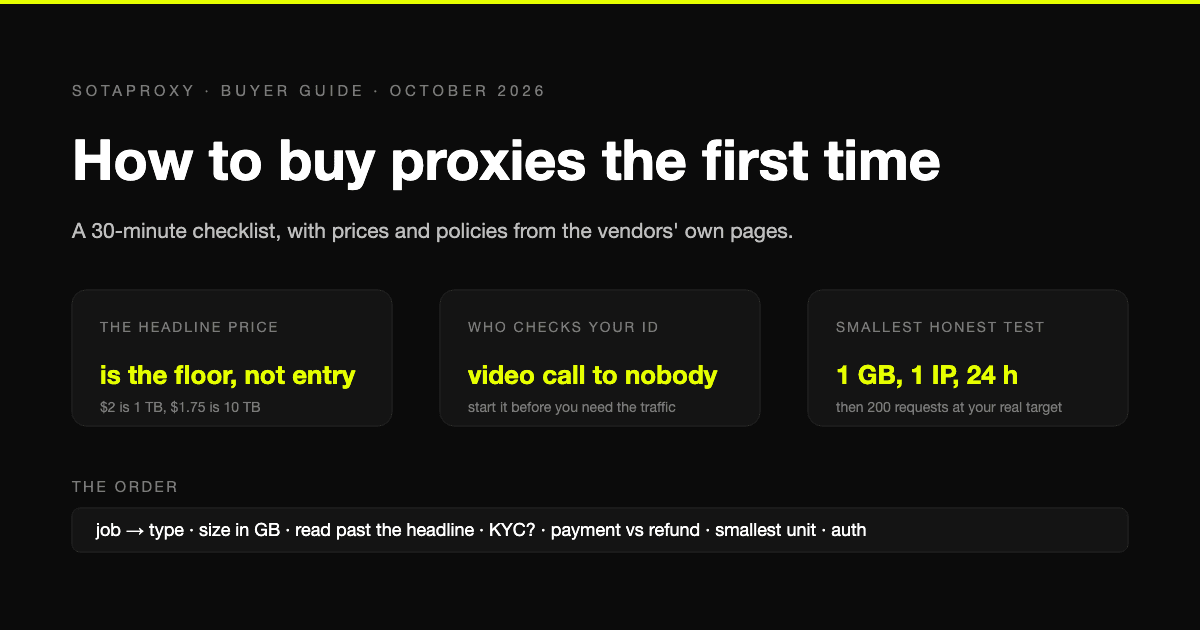
How to Buy Proxies for the First Time: A 30-Minute Checklist
A first purchase goes wrong in predictable places: the wrong proxy type, a headline price nobody pays, an identity check nobody mentioned, a refund that does not apply to how you paid. The checklist, with prices and policies from the vendors' own pages.
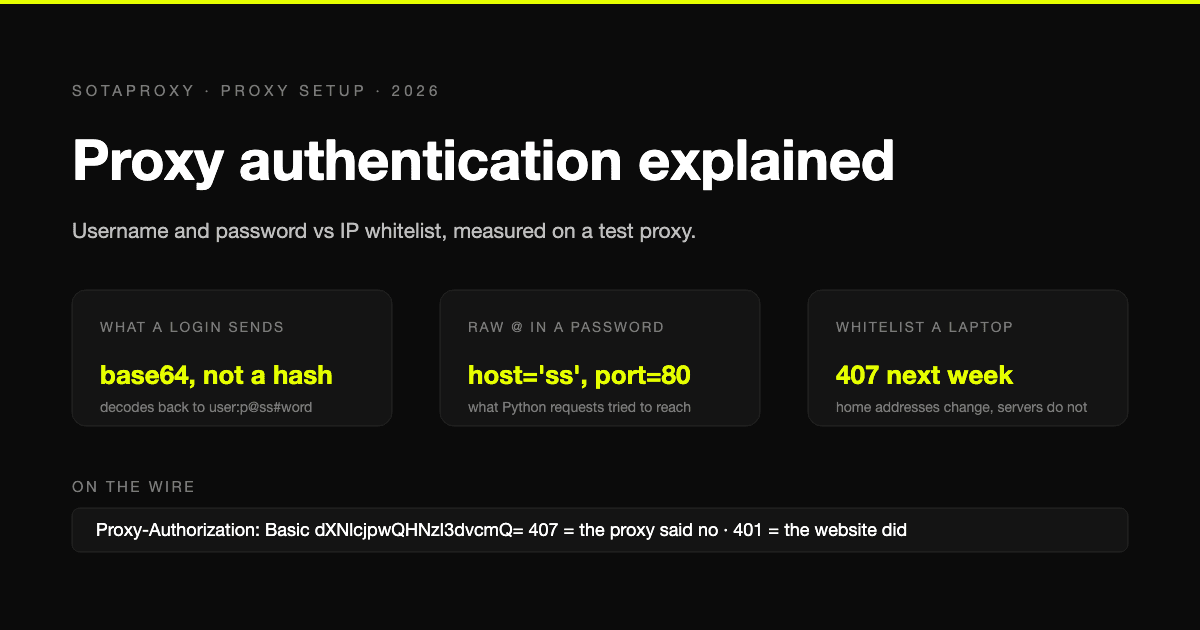
Proxy Authentication Explained: Username and Password vs IP Whitelist
Two ways a proxy knows it is you: credentials sent on every connection, or a list of addresses allowed in without them. What each one puts on the wire, measured on a test proxy, which tools cannot do which, and why a whitelisted laptop breaks a week later.
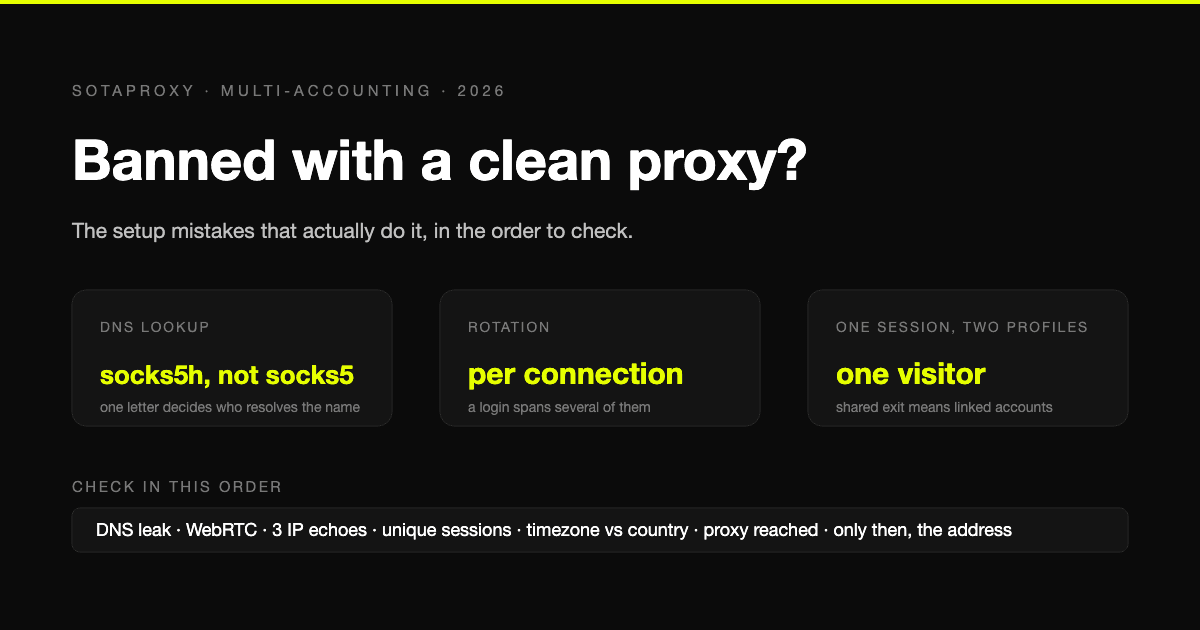
Banned With a Clean Proxy? The Setup Mistakes That Actually Do It
The proxy was clean, the address was residential, and the account still died. In most cases we see, the address was never the problem. Seven setup faults, each one checkable in a minute, in the order they usually turn out to be the cause.
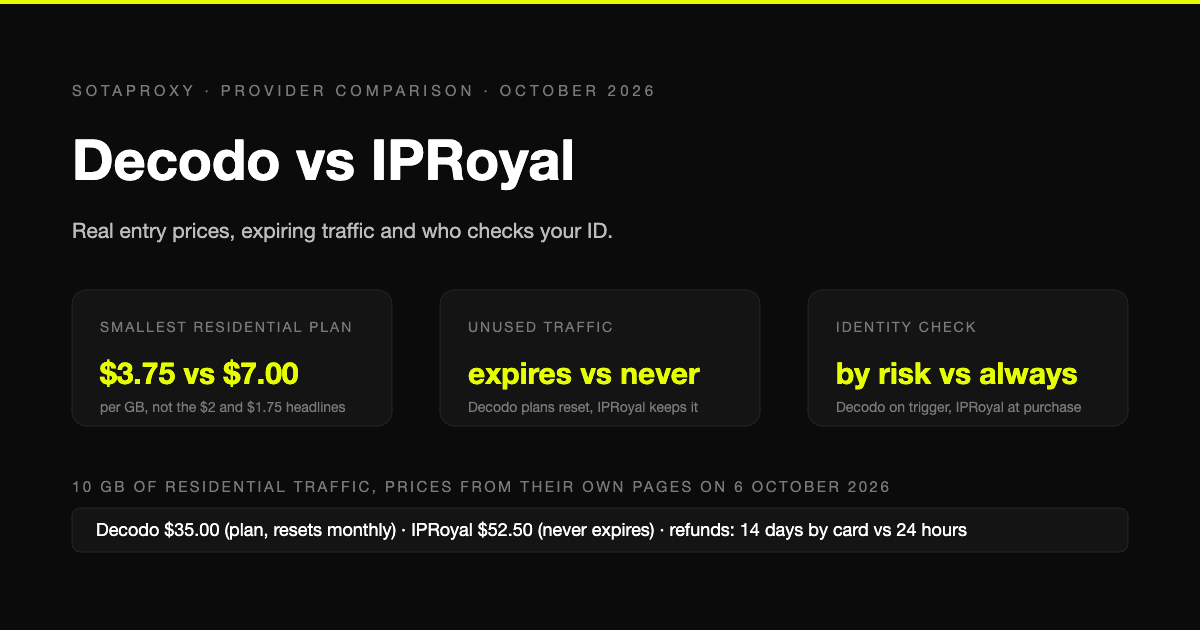
Decodo vs IPRoyal in 2026: Real Entry Prices, Expiring Traffic and Who Checks Your ID
Both are mid-market proxy vendors that take cards and crypto and sell by the gigabyte. The prices on their own pages on 6 October 2026, why neither headline rate is an entry price, whose traffic expires, who checks your identity before you can buy, and who gives money back.
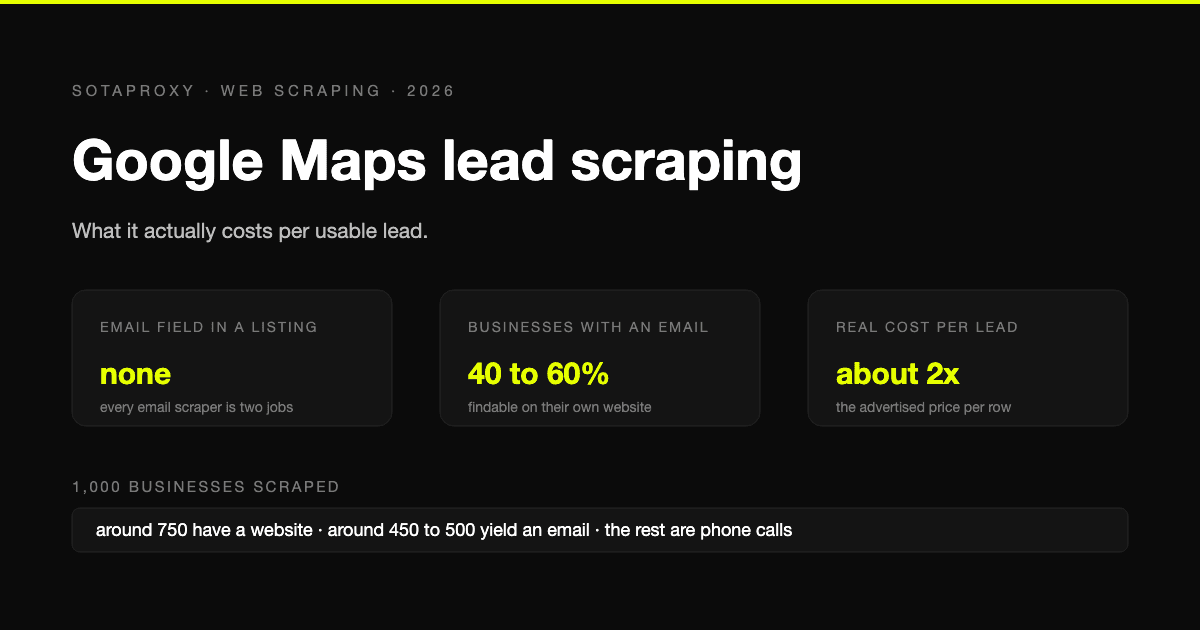
Google Maps Lead Scraping: What It Actually Costs Per Usable Lead
Google Maps has no email field, so every email scraper is a two-stage pipeline and only about half of businesses yield an address. What a thousand listings really costs per usable lead, the businesses-without-websites play, and where the law stands after the SerpApi ruling.
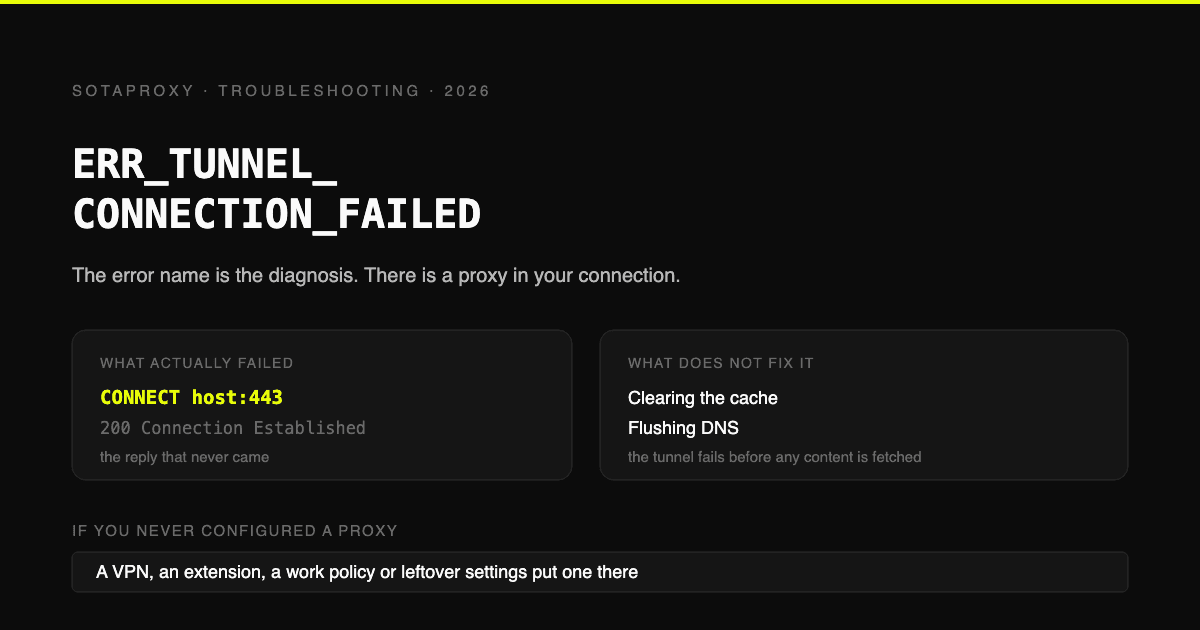
ERR_TUNNEL_CONNECTION_FAILED: The Error Name Is the Diagnosis
Chrome asked a proxy to open a CONNECT tunnel and it failed. That is the whole error. Where the proxy comes from when you never configured one, the six ways a proxy you did configure produces it, and why clearing your cache fixes nothing.