Mastering Consumer Behavior Analysis for Arbitrage
Master consumer behavior analysis for traffic arbitrage & account farming. Learn data collection, proxy workflows, & analysis for Facebook & TikTok.

Most advice on consumer behavior analysis starts from the wrong assumption. It assumes the event stream is clean, the user journey is trackable, and the geo attached to each visit is trustworthy. That might be fine for a basic ecommerce dashboard. It breaks fast when you're running Facebook and TikTok ad accounts across AdsPower, Dolphin Anty, GoLogin, Multilogin, or Hidemyacc, testing cloaked flows, and pushing geo-targeted campaigns through multiple account clusters.
In arbitrage, bad data doesn't just blur reporting. It gets accounts flagged, creatives misrouted, and spend pointed at the wrong audience. If you're farming accounts, validating offers, scraping local SERPs, or checking region-specific ad delivery, the first question isn't "what did the user do?" It's "did this event come from the place and device context it claims to come from?" Most guides skip that. They go straight to segmentation and dashboards.
Table of Contents
- Why Most Consumer Behavior Analysis Fails
- Core Frameworks and Actionable Metrics
- Data Collection for High-Risk Operations
- Essential Analysis Techniques for Arbitrage
- Use Cases and Pitfalls in Ad Management
- Building Your Technology Stack
- Implementing a Profitable Analysis System
Why Most Consumer Behavior Analysis Fails
Most consumer behavior analysis fails because teams trust the label on the data more than the origin of the data.
If you're buying traffic, farming accounts, or validating campaign performance across regions, that's a mistake. You can't build reliable segments from logs polluted by bots, spoofed locations, synthetic reviews, and mismatched device context. The Data Provenance Gap is the part most mainstream analytics content ignores.
A cited overview of that gap states that 68% of consumer behavior datasets used in 2024–2025 contained location-inconsistent or bot-generated entries, and 22% of e-commerce interaction data globally came from AI-generated reviews and synthetic traffic according to the referenced discussion of the Data Provenance Gap. If your audience model includes that noise, your "insights" are often just artifacts from bad collection.
The first failure point is geo trust
Traffic arbitrage teams usually notice this after money is already gone. A landing page converts in one city, falls apart in another, and the dashboard says the audience behaved differently. Sometimes they did. Sometimes the location data was wrong from the start.
That matters for more than reporting. It affects ad review outcomes, account warm-up patterns, localized offers, and cloaking logic. A bad geo assumption can poison a whole account batch.
Practical rule: Verify geography before you interpret behavior. If you skip that step, every later model inherits the error.
A lot of teams treat proxy hygiene as an ops problem and analytics as a reporting problem. In practice they're the same system. If the collection layer isn't clean, your behavior analysis isn't analysis. It's guesswork with charts.
Most dashboards explain outcomes too late
Standard dashboards are built around lagging indicators. Spend, CTR, conversion count, maybe some replay clips. That's not enough for high-risk operations. You need to know whether the user session was authentic, whether the path was regionally valid, and whether the account context matched the platform's expectations.
For operators who also do scraping or local market validation, this becomes obvious fast. Clean research starts with a verifiable collection method, not a polished dashboard. A good primer on that distinction sits in this piece on how market research depends on data quality.
Core Frameworks and Actionable Metrics
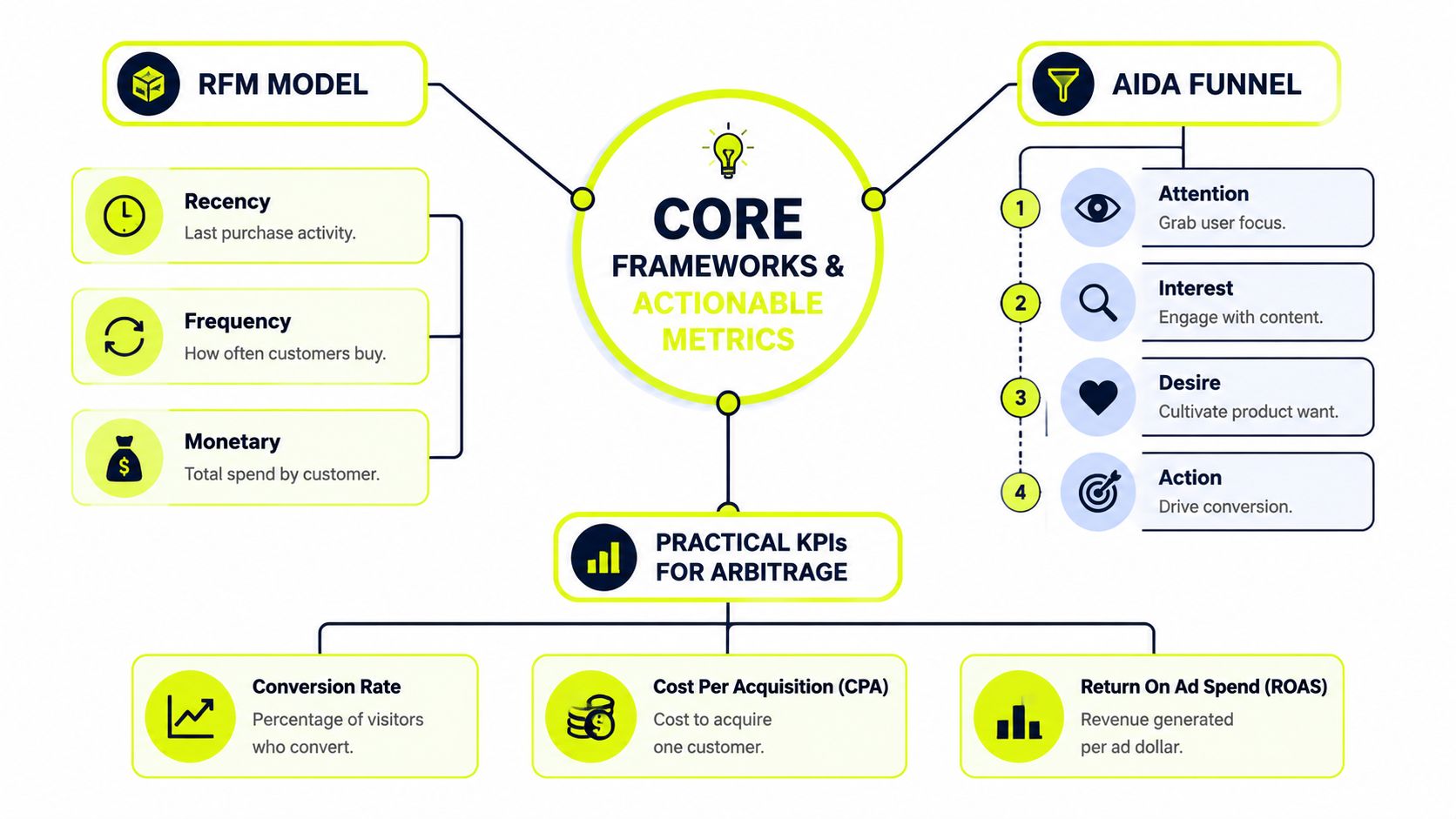
Frameworks like RFM and AIDA still work. They just need to be translated into operator language. If you leave them as slide-deck theory, they won't help you manage Facebook ad accounts, debug a TikTok funnel, or decide whether a cloaked prelander is filtering the wrong users.
Turn classic models into operator metrics
RFM is useful when you're ranking traffic quality after the click.
- Recency tells you how recently a user acted. In arbitrage terms, this helps separate fresh responders from recycled traffic.
- Frequency shows repeat interaction. That's useful when retargeting loops, repeated ad exposure, or account revisit patterns start affecting approval and conversion behavior.
- Monetary is still the commercial layer. In practice, teams often map it to order value, payout quality, or downstream buyer quality.
AIDA is better when you're diagnosing creative and funnel mismatch.
- Attention. Did the ad stop the scroll?
- Interest. Did the user engage with the landing page instead of bouncing into a back click loop?
- Desire. Did the session show product intent, offer comparison, or strong CTA exploration?
- Action. Did the user complete the target event without friction?
The value isn't in naming the stages. The value is in tying each stage to observable behavior inside a real traffic stack.
Use struggle signals as an early warning system
One of the few metrics that helps day to day is the Struggle Score. A referenced guide describes session-level struggle metrics such as rapid cursor reversals and repeated error pop-ups, and states that this score correlates with a 34% higher probability of transaction dropout. The same source says teams that track and fix those friction points can recover approximately 22% of otherwise lost revenue according to Glassbox's guide on customer behavior analysis.
That matters because struggle shows up before your top-line conversion report gets ugly.
Watch for hesitation patterns, not just exits. A user who loops, stalls, retries fields, or reverses direction is telling you where the funnel is about to leak.
For arbitrage teams, the practical dashboard usually includes:
- Session friction flags tied to checkout fields, redirect points, or geo-gated page elements.
- Creative-to-lander continuity so you can spot when the ad promise and page reality don't match.
- Platform-specific breakpoints because a TikTok click often behaves differently from Facebook traffic on the same destination.
- Approval-risk signals when account behavior starts drifting from the expected geo or device pattern.
A bounce rate won't tell you that a shipping overlay broke for one region, or that a cloaking rule served the wrong page variant to a clean session. A struggle-oriented view often will.
Data Collection for High-Risk Operations
Collection changes when the operation is high risk. You're not just gathering analytics events. You're trying to gather them without blocks, false geo labels, poisoned sessions, or account review triggers. That's why proxy choice has to follow the task.
Pick proxy type by task, not by habit
Operators often default to one proxy type for everything. That's lazy and expensive. Residential, mobile, datacenter, and IPv6 each solve different problems.
For social account work, mobile traffic has a specific edge. A cited source says mobile proxies provide a 35% higher success rate for account farming on TikTok and Instagram compared to residential proxies because those platforms trust the mobile carrier's IP header, or ASN. The same source states that datacenter proxies have a 95% failure rate for these tasks because they don't carry that trust signal, as noted in this overview of behavior analysis and platform trust patterns.
That lines up with what operators see in the field. If you're logging TikTok or Instagram accounts inside AdsPower, Dolphin Anty, GoLogin, Multilogin, or Hidemyacc, mobile is often the safer lane for login reputation and account farming. Residential still matters for many browser-based consumer simulations, local checks, and long-session work. Datacenter is useful where speed matters more than trust. IPv6 is often cost-efficient for broad geo coverage and large-volume validation, but it isn't a universal replacement for trusted mobile or city-matched residential sessions.
Proxy Type Comparison for Consumer Data Collection
| Proxy Type | Primary Use Case | Trust Score | Cost | Best For |
|---|---|---|---|---|
| Residential | Geo-consistent browser sessions | High | Higher | Facebook account management, local offer checks, cloaking validation |
| Mobile | Carrier-backed social activity | Very high on mobile-forwarded platforms | Highest | TikTok and Instagram account farming, ad verification in mobile-heavy flows |
| Datacenter | Fast bulk requests | Low for sensitive account work | Lowest | Non-sensitive scraping, internal testing, high-speed fetch jobs |
| IPv6 | Wide-scale geo distribution and cost control | Varies by target and infrastructure quality | Lower relative cost at scale | Geo-targeted campaigns, broad ad verification, large routing pools |
Use cases matter more than labels.
- Residential fits when city consistency matters. That's common with Facebook ad accounts, region-locked offers, and local SERP collection.
- Mobile fits when the platform grades trust through carrier context. That's where TikTok and Instagram workflows get less forgiving.
- Datacenter fits speed-first collection. Don't use it for sensitive account warm-up and then act surprised when the platform treats the session as synthetic.
- IPv6 fits coverage and cost control. It's practical for geo-targeted campaigns and validation jobs when the target accepts the network profile.
If you're building crawlers around ad intel, local pricing, or market snapshots, the collection method has to preserve session integrity. This guide on Python web crawling workflows is useful for thinking about parser design and request flow without reducing the problem to just "send more requests."
Essential Analysis Techniques for Arbitrage
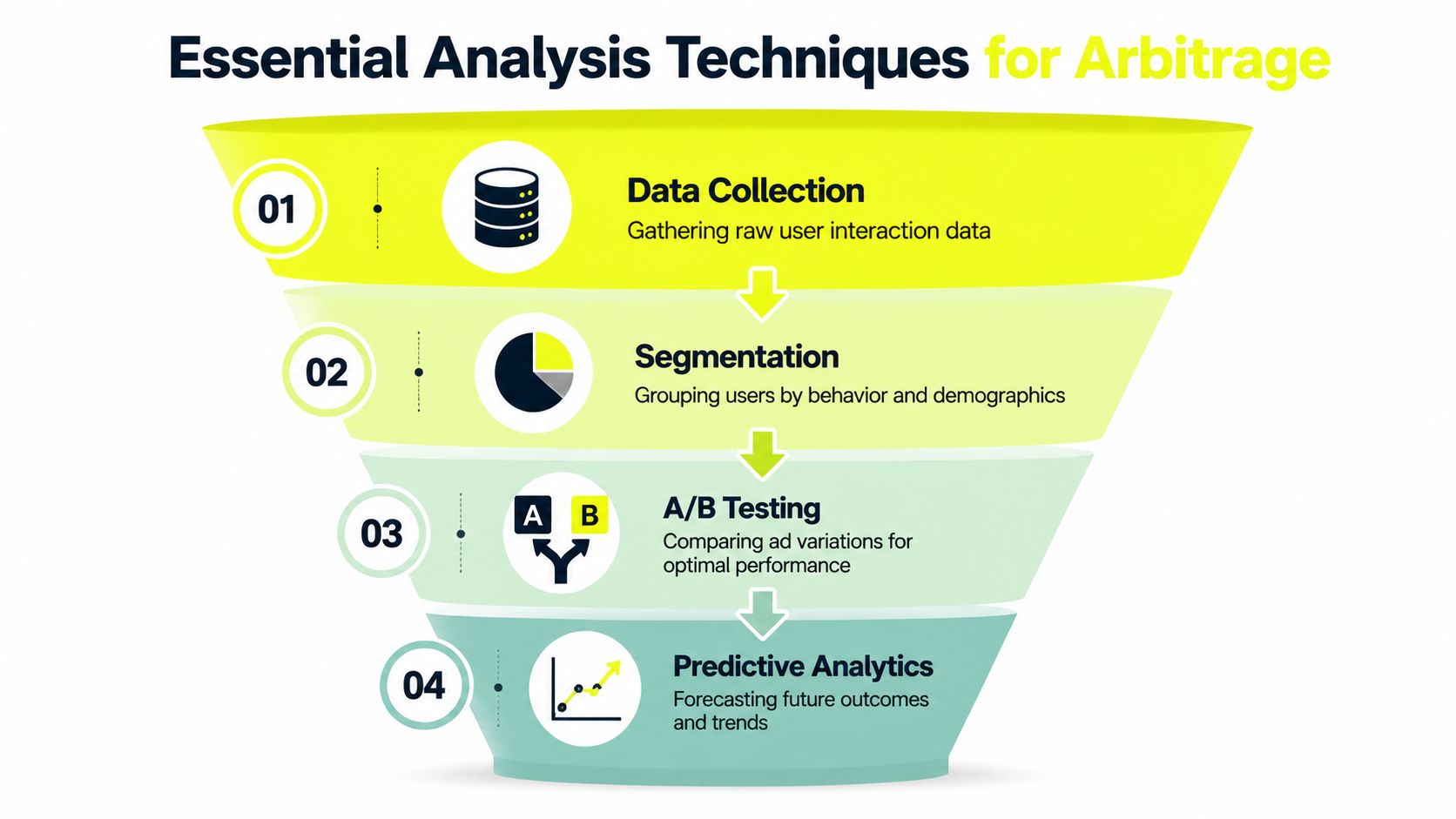
Once the collection layer is stable, the next job is interpretation. In arbitrage, four techniques do most of the useful work. Behavioral segmentation, cohort analysis, funnel analysis, and attribution logic. They sound standard. They aren't standard when traffic crosses cloaked landers, messenger apps, third-party checkouts, and multiple account environments.
Behavioral segmentation beats broad audience buckets
Demographic segments rarely help much at the media-buying layer. Behavior does.
A useful operating model is to split users by observable decision style:
- Decisive clickers move cleanly from ad to offer with low hesitation.
- Hesitant buyers compare, rewind, pause, and need cleaner reassurance.
- Offer skeptics engage but avoid the final commit step.
- Misrouted traffic lands, scans, and shows immediate mismatch behavior.
Those segments are practical because each one points to a different fix. Decisive clickers can usually handle a shorter path. Hesitant buyers often need fewer form fields, cleaner pricing, or stronger trust markers. Misrouted traffic usually means the creative, placement, or geo logic is off.
The best segment is the one that tells the buyer what to change next.
For teams that process large event exports or scrape competitor structure into their own models, it helps to normalize event schemas before analysis. This walkthrough on working with XML and Python data flows is relevant if your traffic data or marketplace feeds arrive in ugly formats.
Funnels cohorts and attribution in fragmented journeys
Cohort analysis works when you group users by acquisition moment or source. A cohort from one TikTok creative batch often behaves very differently from a Facebook retargeting cohort, even when both hit the same offer. The point isn't just retention. It's pattern stability. If one cohort starts showing more delay, more page loops, or weaker downstream actions, the source quality likely changed.
Funnel analysis matters even more in cloaked and prelander-heavy setups. You need to map the exact drop points. Did users fail before the bridge page, after the offer reveal, or inside the checkout flow? Operators often blame the ad too early when the underlying issue lies in redirect timing, page mismatch, or a region-specific element that breaks confidence.
Attribution is the messy one. In real arbitrage paths, users might hit TikTok, move to WhatsApp, reopen via browser, and purchase inside an app or external cart. Standard single-platform attribution loses that chain. Cookie dependence doesn't hold up well in fragmented environments, so teams usually fall back to a practical blend of click identifiers, geo consistency, session timing, and offer-level reconciliation.
A/B testing belongs here too, but only after you've stabilized routing and tracking logic. Testing creatives on top of broken stitching just produces cleaner-looking noise.
Use Cases and Pitfalls in Ad Management
The biggest mistakes in ad account operations don't come from bad creative. They come from bad environment control. That's where consumer behavior analysis becomes operational, not academic.

A common setup looks like this. One team manages Facebook and TikTok ad accounts across AdsPower or Dolphin Anty. Another team handles landers, cloaking logic, and spend rotation. A third team watches approval, bans, and account health. If those groups don't share the same view of behavior data, they start solving the wrong problem.
A cited source states that over 90% of Facebook ad account suspensions in 2024 were triggered by automated systems detecting suspicious activity, primarily inconsistent geo-location data, and that pairing antidetect browsers with residential proxies that match an account's registered city is essential to avoid the location mismatch flag, according to this Facebook-focused behavior analysis article.
Where account farms usually break
The first break is IP-to-account mismatch. An account is registered in one city, then logs in from another context that doesn't fit prior behavior. That alone can trigger review pressure.
The second break is cross-contamination. Operators reuse browser fingerprints, session routes, or proxy pools across accounts that should stay isolated. Then they wonder why healthy accounts start failing in clusters.
The third break is false diagnosis. The buyer sees performance drop and changes creatives, budgets, or cloaking rules when the issue is session trust degradation.
For teams working heavily on Meta, this guide on choosing a proxy for Facebook account workflows is useful because the platform punishes sloppy geo handling faster than often acknowledged.
If several accounts degrade at once, don't assume the offer died. Check location consistency, browser isolation, and session quality first.
What good operators watch across account cohorts
Good teams don't just monitor conversion. They monitor behavior drift across account groups.
- Account login behavior that suddenly changes by region or browser profile.
- Creative response patterns that diverge between Facebook and TikTok traffic.
- Landing-page hesitation that appears only in one geo-targeted campaign branch.
- Review and approval timing that starts slowing on one cohort of farmed accounts.
That kind of monitoring helps you catch platform updates indirectly. You see the symptoms first. A cohort of accounts starts acting "clean" on paper but receives harsher review outcomes. Or users from one region begin stalling on a form that was previously stable.
Here's a useful walkthrough on the broader environment these teams operate in:
Cloaking adds another layer. If your filter logic sends the wrong page variant to real users, the behavior data becomes misleading fast. A spike in hesitation might not mean the offer is weak. It might mean the clean path and the monetized path no longer align.
Building Your Technology Stack
A workable stack for consumer behavior analysis in arbitrage has four layers. Collection, identity control, storage, and interpretation. If one layer is weak, the rest turns into cleanup.
What the stack needs to do every day
First, you need collection inputs. That usually means ad platform exports, click logs, site events, replay tools, scraped market data, and moderation signals from your account ops team.
Second, you need identity isolation. For this, antidetect browsers like AdsPower, Dolphin Anty, GoLogin, Multilogin, and Hidemyacc matter. They're not analytics tools, but they preserve the separation required to trust the behavior attached to a profile or account cluster.
Third, you need proxy-backed execution. Different tasks need different routing. Account farming, cloaking checks, local ad verification, scraping, and geo-targeted campaign review shouldn't all run through the same path.
Fourth, you need processing and automation. Scripts normalize logs, tag session anomalies, and reconcile outcomes across platforms. Browser automation also matters here. If you're instrumenting checks or building repeatable validation jobs, this guide on using Playwright in proxy-based workflows is a practical reference.
A lean stack is usually better than a crowded one. If a tool doesn't help you validate geo, isolate identity, detect friction, or improve budget allocation, it's probably just adding noise.
Implementing a Profitable Analysis System
Start with one campaign, one funnel, and one account group. Don't try to map the whole operation on day one. Clean up the collection layer, verify geo consistency, tag hesitation patterns, and compare those signals against actual conversion and approval outcomes.
Then scale only what stays reliable. Apply the same logic to your TikTok account batch, your Facebook retargeting group, or your cloaked geo campaign set. Keep account isolation strict. Keep proxy selection task-specific. Keep reporting tied to actions the buying team can take.
There's also a practical cost angle here. A cited source states that Sota Proxy's referral program offers up to 40% recurring commission, which can help offset infrastructure spend while teams expand proxy usage across 220+ geolocations and manage 100+ simultaneous ad accounts for account farming, according to this reference to consumer behavior research infrastructure.
A profitable consumer behavior analysis system isn't the one with the prettiest dashboard. It's the one that helps the team make fewer bad decisions, lose fewer accounts, and move budget faster toward traffic that holds up under scrutiny.
If you're running account farms, geo-targeted campaigns, scraping pipelines, or ad verification at scale, Sota Proxy gives you the infrastructure layer that keeps the data clean enough to trust. It supports residential, mobile, ISP, datacenter, and IPv6 routing across 220+ geolocations, which fits actual workflows behind AdsPower, Dolphin Anty, GoLogin, Multilogin, and other multi-account setups. For operators who need stable routing, city-level targeting, and room to scale without rebuilding the stack every month, it's a practical place to start.
Related articles

Multiple Account Management a Secure Scalable Framework
Build a secure, scalable multiple account management system. This guide covers threat modeling, proxies, antidetect browsers, and automation for media buyers.

An Affiliate Marketing Guide for Arbitrage Teams
A no-fluff affiliate marketing guide for traffic arbitrage and media buyers. Learn to manage ad accounts, use proxies, and scale campaigns on FB & TikTok.

7 Data Collection Methods for Media Buyers & Farmers
Explore top data collection methods for media buyers. Learn to leverage scraping, APIs, and surveys for ad accounts, account farming, and geo-targeting.
Proxy Pay as You Go Pricing: Master Costs 2026
Master pay as you go pricing for proxies. Guide for arbitrage & account farmers on billing, cost control, and choosing IPs. Optimize spend.

Rotating Proxy Server: Mastering Techniques for 2026
Master rotating proxy servers for farming, ad verification & scraping. Learn architecture, rotation, & anti-detection tactics.

Secure Your Ads: Avoid a Free Rotating Proxy in 2026
A free rotating proxy poses major risks to Facebook/TikTok ads and antidetect browsers. Understand the security dangers and why paid proxies are essential for