Canada Proxy Server Guide for Ad & Account Operators
Use a Canada proxy server for multi-account ops. This guide compares residential, mobile, and datacenter IPs for Facebook, TikTok, and antidetect browsers.
You launch a campaign. Creatives are clean. Warmup looked fine. Then Facebook asks for another checkpoint, TikTok starts forcing re-verification, or your antidetect profiles suddenly stop holding sessions. Many operations point to the browser profile, cookies, or the farm. A lot of the time, the weak point is the IP.
That's why a Canada proxy server matters less as a geography trick and more as part of your trust stack. If you run dozens of ad accounts in AdsPower, Dolphin Anty, GoLogin, Multilogin, or Hidemyacc, you already know the pattern. A bad proxy doesn't always fail fast. It fails subtly. Logins become fragile. Spend pacing gets weird. Review flows get stricter. Cloaking paths start behaving inconsistently by region.
This market isn't niche anymore. The global proxy server service market is projected at US$1.13 billion in 2026 and US$2.04 billion by 2035, with a 6.5% CAGR, according to Business Research Insights on the proxy server service market. That matters because providers now compete on uptime, targeting, and session control, not just raw access.
Table of Contents
- Your Proxy Is the Weakest Link
- Why Use a Canada Proxy for Geotargeting
- Proxy Types Compared for Account Operations
- How to Select a Canada Proxy Provider
- Setup and Configuration for Antidetect Browsers
- Legal, Ethical, and Operational Checks
Your Proxy Is the Weakest Link
If you're managing Facebook ad accounts, TikTok ad accounts, account farming flows, or cloaking infrastructure, proxy quality decides how much friction you absorb each week. Not because a proxy solves everything. Because platforms score consistency across signals, and the IP is one of the few signals you control directly.
A weak Canada proxy server usually shows up in boring ways first. Session drops. Extra verification. Logins from a city that doesn't match the profile story. One profile survives, another dies, even though both use the same antidetect setup. That's not random. It's what happens when the network layer is unstable or overused.
Practical rule: If an account workflow is high value, treat the proxy like account infrastructure, not disposable tooling.
The market has matured, but that hasn't made the decision easier. It just changed the question. You no longer ask, “Can I get a Canadian IP?” You ask, “Can this IP hold a browser identity long enough to survive billing events, review checks, and repeated login patterns?”
That's where a lot of teams waste money. They buy by headline. Country. Pool size. Cheap bandwidth. Then they run sensitive account work on the wrong network type. If you're troubleshooting repeated platform friction, this is the first layer I'd audit before changing your browser fingerprints or farming process. A lot of the same failure patterns show up in broader anti-ban workflows, and this guide on how to avoid IP bans is useful if your issue is repeated reuse and reputation decay rather than profile setup.
Why bad proxies are expensive
The loss isn't just bans. It's unstable operations.
- Account handling gets slower because buyers start babying profiles that should run normally.
- Campaign QA gets noisy because geo checks return inconsistent content.
- Antidetect workflows drift because the browser profile looks stable while the IP behavior doesn't.
- Farm output degrades because replacement rates rise and login survival drops.
A proxy doesn't need to be perfect. It needs to fit the task. That's the whole game.
Why Use a Canada Proxy for Geotargeting
A Canada proxy server is useful when you need regional consistency, not just a flag that says “Canada.” For ad verification, local SERP checks, offer validation, app store viewing, and account creation tied to Canadian identity signals, city targeting matters more than the country label.

Canada is one of the more mature proxy geographies in North America. Providers offer city-level targeting across at least 16 Canadian cities, with strong concentration in markets like Toronto (15,797 IPs), Montreal (8,189 IPs), and Ottawa (7,668 IPs), according to Oxylabs coverage for Canada proxies. That density is what makes Canada workable for serious geo-targeted operations.
City targeting is the real advantage
If you buy media in Canada, you already know a Toronto result isn't the same as a Québec result. Ad delivery, local pricing, language variants, and inventory visibility can all shift by city. The practical value of a Canada proxy server is that you can test those differences without rebuilding your whole stack.
Such situations benefit from city-level routing:
- Ad verification for campaigns split by province or metro.
- Localized SERP checks when you need to inspect what users in Toronto or Montreal see.
- Offer and landing page QA for province-specific promos, language paths, or payment variants.
- Account creation and warming when profile location has to match a believable Canadian browsing pattern.
For teams comparing proxy networks, this residential proxy breakdown helps when your main concern is trust and geo realism rather than speed.
A Canadian IP is easy to buy. A Canadian IP in the right city, with enough session stability to support account work, is harder.
Where Canada actually helps
For media buying, Canada is often cleaner than broader North American targeting because you can isolate one market without blending US traffic patterns into the same workflow. That matters for cloaking tests, localized compliance reviews, and creative QA where a regional mismatch can distort what you think the user sees.
It also helps with account narratives. If you're building Facebook or TikTok profiles intended to look native to Canada, city consistency reduces one more mismatch between profile history and current access. It won't save a bad browser setup or aggressive automation. But it gives you a tighter location story.
A few practical uses stand out:
- Toronto works well for mainstream market checks because the pool is deeper and operationally easier to source.
- Montreal and Québec matter when bilingual content and regional ad delivery need validation.
- Ottawa is useful when you want a non-Toronto major-city path without going too broad.
The mistake is thinking “Canada” is one bucket. It isn't. For geo-targeted campaigns, local routing is the product.
Proxy Types Compared for Account Operations
If your workflow involves Facebook, TikTok, AdsPower, Dolphin Anty, GoLogin, Multilogin, or Hidemyacc, proxy type matters more than the country itself. Trust level changes by network origin. That directly affects account survival, login friction, and how often you end up replacing profiles that should've stayed alive.
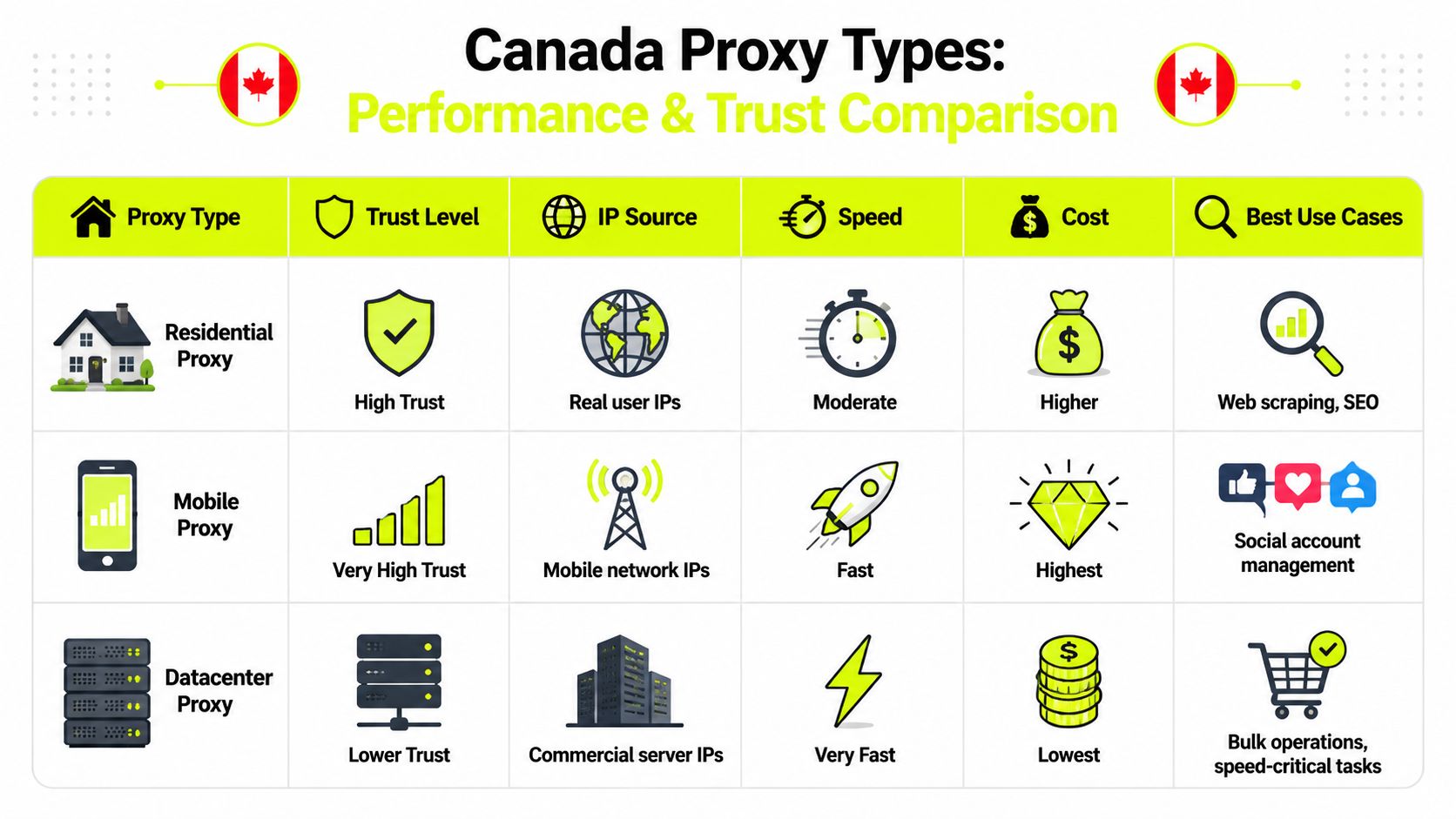
A 2026 review noted that mobile and ISP-sourced IPs are typically used for high-trust, lower-ban-rate operations, while basic datacenter IPs are easier for platforms like Facebook and TikTok to detect, as covered in CyberYozh's review of Canadian proxy options. That lines up with what most account operators see in practice.
Residential for stable account work
Residential proxies are usually the safest default for Canada account operations when you need a believable consumer connection. They map to ISP-assigned traffic patterns better than datacenter IPs, which is why they're common in account farming, ad account access, and regional browser profile management.
They're especially useful when the task depends on session continuity. Logging into a Facebook profile, revisiting Business Manager, reviewing spend history, or entering TikTok Ads Manager all benefit from an IP that behaves like a real household route instead of a commercial server exit.
Residential works best for:
- Account farming
- Warming social profiles
- Daily access to ad accounts
- Geo-sensitive cloaking checks
- Longer browsing sequences inside antidetect tools
The trade-off is speed and cost. Residential isn't the cheapest path, and if your provider recycles dirty IPs, the trust benefit disappears fast.
Mobile for high trust workflows
Mobile is what teams reach for when they care most about trust. If you're running sensitive account recovery, aged profile access, or repeated login activity that tends to trigger risk checks, mobile usually gets more tolerance from platforms than basic datacenter routes.
That doesn't mean it's magic. Mobile can still fail if the browser fingerprint is sloppy, the account behavior is reckless, or the region story doesn't make sense. But for high-stakes workflows, mobile tends to be the safer side of the risk curve.
Use mobile when:
- the account is valuable enough to justify higher cost
- you need the cleanest trust profile available
- you're dealing with repeated checkpoints or fragile account histories
- your team can tolerate less predictable routing in exchange for safer access
Datacenter and IPv6 when speed matters more than trust
Datacenter proxies still have a place. They're fast, cheap, and useful for tasks where trust isn't the main variable. If you're scraping public pages, checking ad availability at scale, or running speed-critical automation that doesn't require account persistence, datacenter can be fine.
Where teams get burned is using datacenter for Facebook or TikTok account management because it's convenient. That's the wrong job for the network type. Basic datacenter IPs are easier to classify, and on account-based platforms that classification matters.
IPv6 deserves a separate note. It can be useful for scale and cost control in some automation environments, but platform support and detection behavior vary by target. For sensitive account work, don't assume IPv6 alone gives you trust. The source and reputation still matter more than the protocol version.
If the task needs identity persistence, optimize for trust first. If the task needs throughput, optimize for speed first.
For a broader technical breakdown of how these categories differ, this overview of proxy types is a good reference.
Canada Proxy Types A Technical Comparison
| Proxy Type | Trust Score | Typical Cost | Performance/Speed | Ideal Use Case |
|---|---|---|---|---|
| Residential | High | Higher | Moderate | Facebook and TikTok account access, account farming, antidetect browser sessions |
| Mobile | Very high | Highest | Fast | High-trust account recovery, fragile profiles, sensitive ad account workflows |
| Datacenter | Lower | Lowest | Very fast | Bulk automation, scraping, ad verification where account trust isn't central |
| IPv6 datacenter | Lower | Lower | Very fast | Scale-heavy non-sensitive tasks, testing environments, broad request distribution |
No single type wins everywhere. Good operators split the stack by failure mode. They don't force one proxy type onto every task.
How to Select a Canada Proxy Provider
Most provider comparisons are too shallow for real account operations. They focus on country count, generic speed claims, or dashboard screenshots. That doesn't tell you whether the network will hold a Facebook profile through billing changes or keep a TikTok ad account stable inside GoLogin.
You need to check the provider like an operator, not like a shopper.
What to check before you buy volume
Start with the network itself. Ask how clean the pool feels in actual use. “Clean” won't show up as a metric on the pricing page, but you'll see it in account behavior fast.
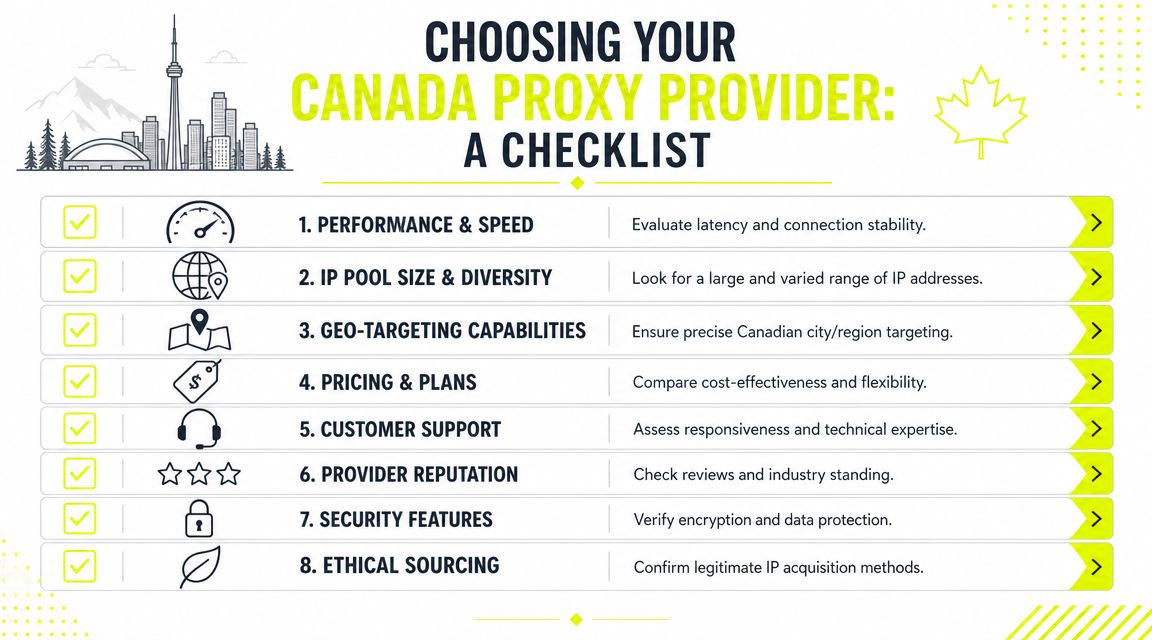
Here's the checklist I'd use:
- Session control matters first. You need both rotating and sticky options. Rotating helps for scraping, ad verification, and request distribution. Sticky matters when one browser profile should keep one story.
- City targeting should be precise. Country-only targeting isn't enough for Canadian campaigns. You want city-level routing if you run geo-targeted offers or region-based account narratives.
- Protocol support should fit your tools. HTTP and SOCKS5 support both matter because different stacks behave better with different protocols.
- Pool diversity beats raw headline size. A giant pool doesn't help if too many IPs feel reused, flagged, or concentrated in the wrong city.
- Support needs to be technical. If support can't answer session, targeting, rotation, and browser compatibility questions, the product usually isn't built for operators.
A provider page or sales rep should also be able to speak clearly about sourcing, targeting granularity, and how sessions are maintained. If those answers are vague, move on.
The best proxy provider isn't the one with the loudest dashboard. It's the one that causes the fewest weird account events.
How to test without burning accounts
Don't start with your best assets. Use throwaway or low-value workflows first and watch for stability patterns.
A practical testing flow looks like this:
- Run low-risk logins first in your antidetect browser of choice.
- Keep the browser fingerprint stable while changing only the proxy variable.
- Test multiple cities if Canada geo precision matters to your operation.
- Separate account tasks from scraping tasks so you don't judge one network by the wrong workload.
- Watch for soft failures such as more checkpoints, location prompts, or inconsistent localized content.
If you manage clients or run several internal buying teams, another practical angle is the affiliate side. Some providers, including Sota Proxy, offer a referral program with up to 40% commission. That won't make a bad network usable, but it can make procurement more efficient if your team already standardizes around one stack.
If you need a baseline technical reference for what a provider is selling when they say “proxy server,” this explainer on making a proxy server helps frame the infrastructure questions worth asking.
Setup and Configuration for Antidetect Browsers
Most proxy problems in antidetect browsers aren't caused by the browser. They come from bad matching between session type and task. If you put a rotating proxy on a profile that should keep one identity, you create your own verification loop.
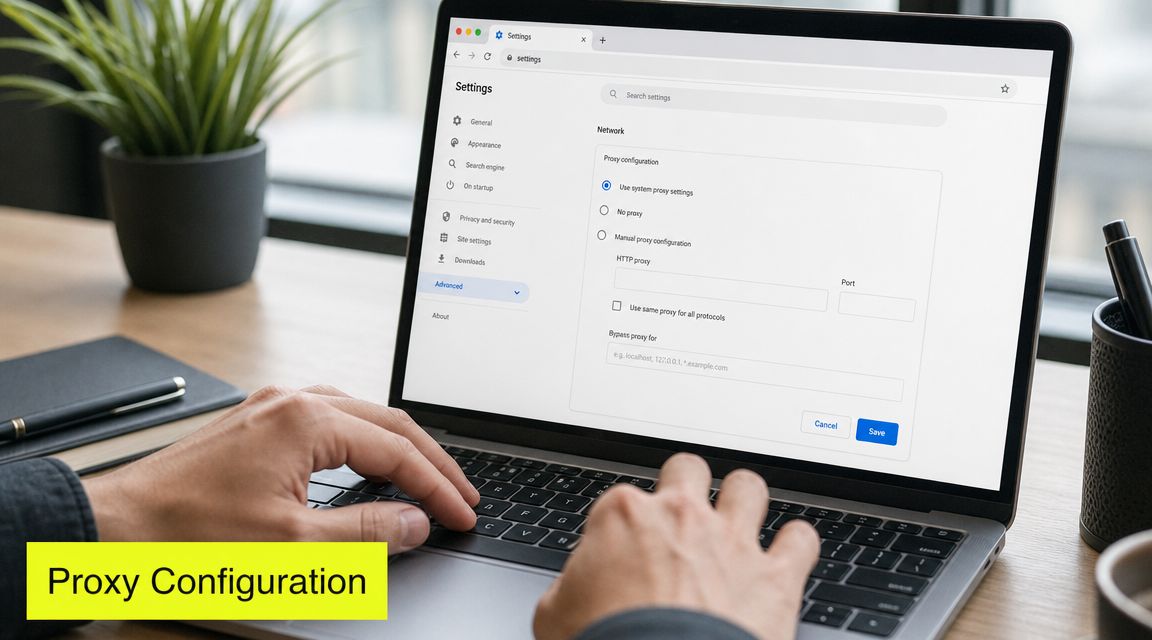
In AdsPower, Dolphin Anty, GoLogin, Multilogin, and Hidemyacc, the setup pattern is mostly the same. You create a profile, assign the proxy, choose the protocol, verify the exit location, then keep that mapping stable for account tasks. The credential format is usually entered as host, port, username, and password or pasted as a single auth string depending on the tool.
Profile setup that holds sessions
For Facebook and TikTok account management, sticky residential sessions are usually the safer setup. Independent provider guidance notes that Canadian residential pools can exceed 143,000 IPs and support rotating and static sessions, according to NodeMaven's write-up on Canada residential proxies. The point isn't the pool headline by itself. It's the session option.
When the browser profile is tied to one login history, keep these elements aligned:
- One profile, one proxy identity. Don't share a session across unrelated accounts.
- Keep timezone and language believable. If the browser says one thing and the IP says another, platforms notice.
- Use SOCKS5 when your stack handles it well. It's commonly preferred for cleaner proxy handling in many automation and antidetect setups.
- Don't rotate during active account sessions. Rotation mid-session breaks continuity.
If you're troubleshooting DNS leaks or mismatched resolution paths inside a browser environment, this proxy DNS guide is useful because a clean IP setup can still leak bad network signals if resolution is inconsistent.
A sticky session is for identity. A rotating session is for distribution. Mixing those up is one of the easiest ways to burn accounts.
Rotation rules by task
For scraping, ad intelligence, or public-page QA, rotating Canada proxies make sense. You want request spread. You don't need one stable identity. For account operations, rotation should be limited, deliberate, and usually happen between sessions, not during them.
A simple task split works well:
- Facebook ad account management uses sticky residential or mobile.
- TikTok profile access also leans sticky, especially when the profile is already seasoned.
- Account farming needs stable sessions during warmup, then careful separation by profile.
- Cloaking checks can use rotating paths for audience simulation, but the admin-side account should stay on a stable route.
- Geo-targeted campaign review depends on whether you are validating public delivery or logging into an account.
This walkthrough is useful if you want to see the browser side visually before rolling the setup across a team:
The cleanest operations keep setup boring. Stable proxy. Stable profile. Stable workflow. Most account safety comes from reducing unnecessary variation.
Legal, Ethical, and Operational Checks
A Canada proxy server is still subject to platform rules, local laws, and data handling requirements. Proxies don't remove that. If your use case touches personal data, regulated markets, or terms-restricted automation, your legal review needs to happen before scaling the stack.
The operational issue is simpler. Free proxy lists are a liability for serious work.
Free proxies break where it hurts
Public Canada proxy lists look attractive when you only need temporary access. But they're open, overused, and not built for account safety. Commercial offerings emphasize unlimited bandwidth, cleaner routing, and controlled session behavior for a reason. Public lists don't solve those problems.
According to ProxyScrape's Canada proxy list page, free proxies are best understood as a trade-off between access and trust, not just access and price. That matches real-world use. Free endpoints may work for one-off checks. They're the wrong tool for Facebook accounts, TikTok spend, antidetect browser fleets, or any workflow where session stability matters.
Use free lists and you'll eventually run into:
- Reused IPs that have already been abused by other users
- Broken session continuity that kills account trust
- Unpredictable routing that ruins geo validation
- No meaningful support path when something fails mid-operation
The compliance side operators ignore
There's also an ethical sourcing angle. If you don't know how a provider sources residential or mobile inventory, you don't know what risk you're importing into your stack. For agencies, affiliate teams, and larger arbitrage operations, that matters.
The other blind spot is internal discipline. Teams often buy the right proxies and still create bad outcomes by reusing them across unrelated accounts, mixing scraping with account logins, or changing too many variables at once. That's not a provider problem. That's operational sloppiness.
Paid infrastructure doesn't guarantee safety. It gives you control. That's the part free lists never deliver.
If you need a proxy stack for Canada that fits ad verification, social account management, scraping, and geo-targeted campaign work, Sota Proxy is built for operator-level use. You get residential, mobile, ISP, and datacenter options, city targeting, sticky or rotating sessions, and support that can help when AdsPower, GoLogin, Multilogin, or Facebook and TikTok workflows start acting up.
Related articles

Buy Proxies for Geo Surfing That Actually Work
Learn how to buy proxies for geo surfing the right way - choose types, target cities, configure antidetect browsers and validate geo results.

What Is Geo Targeting: The Complete Guide for 2026
Learn what is geo targeting and how IP, GPS, and Wi-Fi signals shape it. Residential, mobile, and ISP proxies power real geo-targeted campaigns.
Top Brightdata Alternatives for Proxy Teams in 2026
Explore the best brightdata alternatives for scraping, ad verification, and geo-targeted campaigns in 2026, plus migration tips.

Zip Code Targeting for Ad Campaigns: The Practitioner Guide
Zip code targeting explained for media buyers and traffic arbitrage teams. Covers proxy setup, ad platform rules, detection risks, and best practices.
What Is Forward Proxy: A Complete Guide for 2026
Learn what is forward proxy, how it works for outbound traffic, and why teams use it with antidetect browsers for Facebook, TikTok, and scraping.
What Is a Proxy Used for: 2026 Arbitrage Guide
What is a proxy used for - Learn what a proxy is used for in 2026, from boosting security to managing multi-account operations for arbitrage teams